method · 3 min read
Gua sha, buccal, myofascial: what the videos leave out
Gua sha, buccal and myofascial massage work on different layers of the face. What each one moves, what the research shows and how long results last.
By Zhanna Graeff · November 5, 2026
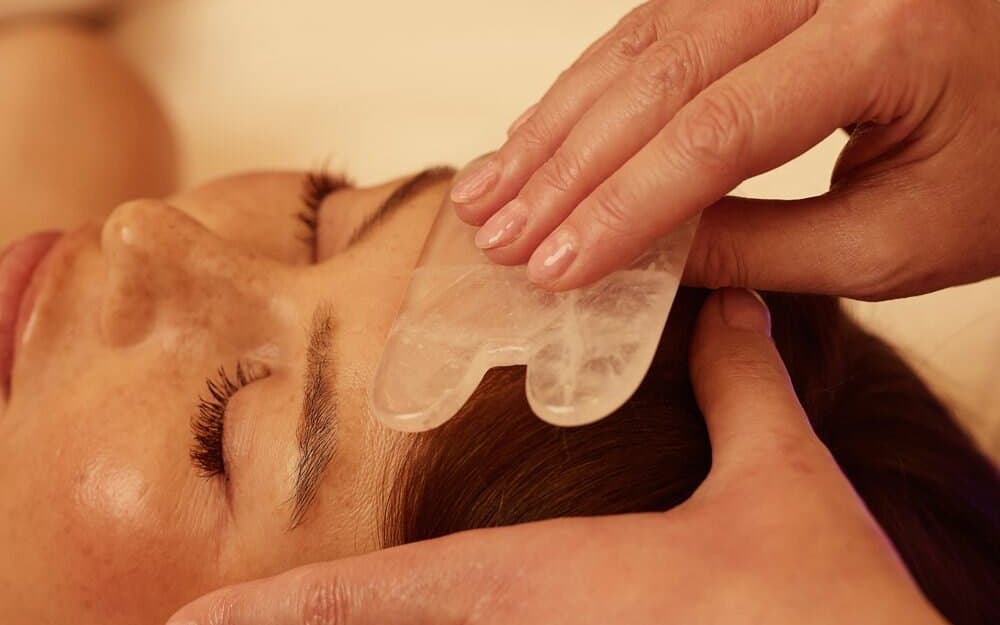
Face-sculpting videos show gua sha stones, buccal massage and myofascial work side by side, often ending with a sharper-looking face. They have taught many people that the face has muscles and fascia that hands can work. They have also blurred a distinction I explain to clients every week: some changes last a day, and others need regular work.
Three techniques, three layers
Gua sha is a smooth-edged tool drawn across oiled skin. It works at the surface and just beneath it, moving fluid toward the lymph nodes and warming the superficial tissue. With light pressure it decongests; with heavy pressure it bruises. The small red dots some people treat as proof it worked are broken capillaries.
Buccal massage works from inside the mouth. With gloved hands I can reach the buccinator in the cheek, the masseter from both sides, and the pterygoid muscles behind the jaw, which no external technique can reach. These are chewing muscles. In people who clench they become very tight, and that tension pulls on the lower face. The Buccal Lift releases them, then lifts the face externally.
Myofascial release works on fascia, the connective tissue that wraps every muscle. Slow, sustained pressure across the cheek, temple, forehead and scalp releases places where it has bound down. The Myofascial Face Lifting Massage is the external counterpart to buccal work. It asks more of the client, so I usually offer it once someone knows how their face responds to buccal or lymphatic sessions.
What the research shows
The best recent study is small. In 2025, researchers in Korea assigned 34 women aged 20 to 50 to ten minutes of facial roller or gua sha self-massage, five days a week for eight weeks (Journal of Cosmetic Dermatology). Both groups showed measurable changes in facial contour on 3D scans. The gua sha group showed lower muscle stiffness; the roller group showed better skin elasticity. Nobody was measured once the eight weeks ended, so the study says nothing about how long the changes last.
This matches what I see in the studio. Fluid moves in an hour. Muscle tension eases over a few sessions and comes back if you keep clenching. Massage does not change bone, does not remove fat, and does not rebuild collagen on its own. Claims otherwise are not supported by the research.
What lasts
Regular work is what lasts. A client who clenches at night and books buccal work every few weeks keeps a softer jaw and a lower face that sits higher than it did. A client who does five minutes of gentle gua sha each morning, with a non-comedogenic oil and light pressure toward the neck, keeps puffiness down. The results are real, but they need to be repeated.
How to use gua sha safely at home
- Always use a non-comedogenic oil, one that will not clog pores. Dragging a tool over dry skin pulls it.
- Keep the pressure light. If it leaves marks, it is too hard.
- Work from the center of the face outward, then down the side of the neck, toward the lymph nodes.
- Skip active acne, a rosacea flare, broken skin, and any area with recent injectables.
- Never attempt intra-oral work on yourself or a friend. The pterygoids sit close to nerves and vessels, and the work needs training, gloves and a health intake first.
In the studio, The Zhanna Method layers all of it in ninety minutes, performed by hand: lymphatic drainage, gua sha, buccal, myofascial and European face lifting, in the order I have refined over years.
Frequently Asked
The questions clients actually ask.
- Is buccal massage better than gua sha?
- They do different work. Gua sha moves fluid and works the surface tissue. Buccal massage releases the chewing muscles from inside the mouth, which a tool cannot reach. Many clients use gua sha at home and book buccal sessions in the studio.
- Does facial massage permanently change your face?
- No. It moves fluid within hours and eases muscle tension over several sessions. It does not change bone or fat. The results hold with regular sessions and fade if you stop.
- Can I do buccal massage on myself?
- No. Intra-oral work reaches muscles that sit close to nerves and blood vessels behind the jaw. It needs training, gloves and a health intake first.
Continue reading
Want to book the treatment this piece is about? See the service page →
Pairs with
From the shelf & the menu.
Pelle Vista
Get the next one in your inbox.
Monthly at most. From the treatment room itself.